Print-on-Demand Income: The Real Numbers After 5 Years
I saw a video on Instagram recently of a creator talking about side hustles, and I made a note of what she said because it stuck with me. The pitch was: why work a nine-to-five when you can start “a cute little side hustle tonight” and let it pay your bills. Design a t-shirt using a free template tool. Push it to a print-on-demand supplier. List it on Etsy. Never touch stock. The supplier prints, packs and ships every order, “they take a small cut, and I just keep the profit from every sale.”
I saved it weeks ago and I’ve been trying to work out why. The mechanics are actually right. Follow every step in that video and it works as described — you honestly can have a live shop by tonight without spending anything.
But two things were said in that video I kept coming back to — “small cut” and “pay your bills”. Both are claims about money. And claims about money can be checked.
So, let’s check them. No eye-rolling at the format, no arguing about whether side hustles are real businesses. Take the video entirely at face value and walk the numbers, the same way you’d walk any product P&L. One claim I can check against the published fee lists. The other I can check against something better: five years of my own sales data, from running exactly the model this video is selling.
The model
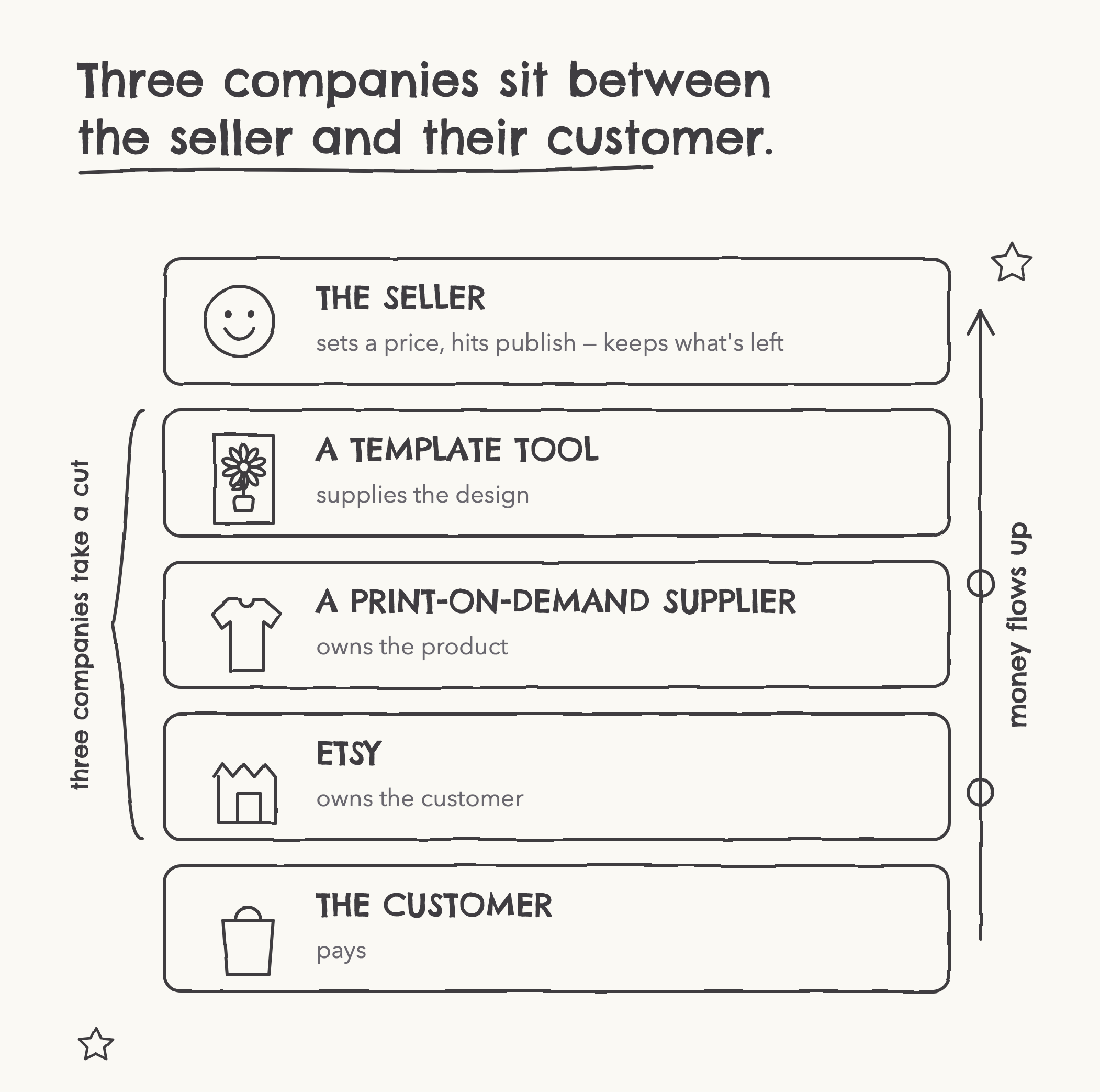
Three companies sit between the seller and their customer.
A template tool supplies the design. The seller’s contribution, in the video’s own words, is to tweak and make it theirs — the artwork comes from the same library every other user is sourcing from.
A print-on-demand supplier owns the product. They hold the base t-shirt , run the printers, pack the parcels, manage the couriers. The seller never sees the shirt.
And Etsy owns the customer. The traffic, the search results, the checkout, the buyer’s details.
The seller sets a price, hits publish and sits at the top of this model collecting whatever is left after everyone below has been paid.
Claim one: they take a “small cut”
Take the standard cotton tee that features on most print-on-demand catalogues, sold at £25 with delivery included. That's a generous retail price — most graphic tees on Etsy sell for less — so this is the model's best case.
The supplier is paid first: around £10.50 for the t-shirt and print, plus roughly £3.60 for UK delivery. That's £14.10 gone before the marketplace takes a penny.
Then Etsy. A 6.5% transaction fee is applied on the full order — £1.63. UK payment processing at 4% plus 20p — £1.20. The listing fee, 16p. A small regulatory operating fee on UK orders, 8p. Adds up to £3.07.
£25, minus £14.10, minus £3.07.
£7.83. On a good day.
Because there’s a fourth participant the video never mentions. Etsy runs Offsite Ads — your listings promoted on Google, Instagram, Pinterest — and if a buyer finds the listing through one of those ads, Etsy takes 15% of the order on top of everything above. That’s £3.75 on our shirt, and the margin drops to £4.08. (Every shop is enrolled by default. Under £10,000 a year in sales you can switch it off; above £10,000, you can’t.)
And £25 was the generous case. Search Etsy for graphic tees and the going rate is closer to £17. Do the maths for the same sale at £17 and the seller keeps about 70p.
Now look at where the guaranteed money sits. The product supplier earns on every unit that is sold, whether the shop makes money or not — their margin is built into the base cost of the t-shirt and never varies with the seller’s fortunes. Etsy earns the listing fee whether the item sells or expires, the transaction fee on every sale, and the ad fee on top when its own marketing works. The template tool earns its subscription either way. The seller is the only participant in the entire chain carrying risk, and the only one whose earnings can shrink to nothing while everyone else still gets paid in full.
They don’t take a small cut. The seller does.
That is claim one checked. The phrase is accurate — it’s just pointing the wrong way round.
Claim two: it pays your bills
This one I don’t need to model, because I’ve been running this exact business for five years.
In December 2021 I started uploading my illustrations to a UK greetings card marketplace. Same structure as the video, different product: I do the creative work, the platform prints, packs, ships and handles the customer. I hold no stock. And for the last few years I haven’t touched it at all — no marketing, no new designs, no attention. It just lives there. This is the purest version of “passive income” you will find: the asset really does sit online earning money while I do other things.
So, here’s what pure passive income looks like with the real numbers.
Total sales since December 2021: 544 cards. My royalty is 40p per card — a figure the platform publishes openly, to its credit. Four and a half years of sales comes to roughly £220.
£220. Total. Not per month. Not per year.
For scale: my weekly food shop for a family of four runs about £110. The entire five-year earnings of this business, saved up and spent in one go, covers a fortnight of groceries.
And before anyone puts this down to the artwork: I have a hit. A card I designed for my nephew's first birthday accounts for 426 of the 544 sales — a real bestseller by the shop's standards, selling steadily day in, day out, for years, entirely on its own. In fact, June 2026 was my best month ever: 33 cards sold. My reward for the best month in five years of running this shop was £13.20.
Now run the video’s claim through it. Say your rent is £1,500 a month. At 40p a card, that’s 3,750 cards — every month. My shop, with its evergreen bestseller compounding for five years, averages ten a month. The gap between “pays your bills” and what this model actually produces isn’t a gap you close with better designs or more effort. It’s two orders of magnitude.
And the thing is, nobody hid this from me. The platform tells you the royalty before you upload a single design. The video’s own script names the fees. The information is all there — the claim survives only because nobody walks it backwards from an actual bill. So, walk it backwards. Take your rent, your mortgage, whatever bill the video promises to pay, divide it by the per-unit royalty, and look at the number of units. It becomes very clear, very fast.
That’s claim two checked.
When this model is actually useful
Here’s the part the videos skip, because it’s less fun: these platforms are not useless. They’re mispositioned.
If you’re starting out with little capital, no supplier network, and no experience finding manufacturers — and no budget to hire someone who does that for a living— this model solves a real problem. You can put a design on a physical product and in front of real customers for nothing and find out whether anyone wants it before you commit money to it.
In conventional product development, that test isn’t free. A sample typically costs somewhere around twice the wholesale price of the finished unit — not a fixed rule, but the common practice. Print-on-demand inverts that: you get a made, shipped, customer-tested product at a per-unit cost that would be a mess as a business model but is entirely reasonable as a sampling budget. Order one of your own t-shirts and call it what it is — a sample. Test the pattern. Test the price. Watch whether strangers buy.
Then, if the answer is yes, people want it, go and build the actual business: a manufacturer, a real margin, a customer list you own. The platform was the test, not the model. Because as a permanent way of making your product, this model costs you far more per unit than making it properly ever would — you’re paying every layer’s guaranteed margin, forever, out of yours.
There’s a second reason this can’t be the long-term model, and it’s the one that bothers me as a product developer: you have no control over the product. The base t-shirt is whatever the platform buys. You don’t choose the fit, the sleeve, the shape of the collar, the rib, the fabric weight, or the country of origin. Your control ends at the artwork. You can’t answer the most basic question a customer might ask — where does this come from?
And that matters commercially, not just professionally. A product business stands for something, and the supply chain is one of the ways you prove it. Traceability isn’t mandatory, but it has become real added value — customers come back to businesses that can show the thinking behind the product. If you can’t say where your own t-shirt was made, that tells the customer something about your business too. As the person who owns the product, living with whatever you’re given isn’t good enough.
To be fair, some creators do make decent money on these platforms — a small percentage, at the top of each marketplace. But look at what they’re doing to get there: uploading the maximum number of designs allowed, refreshing constantly, marketing and promoting their listings week in, week out. That’s not a side hustle or passive income. That’s a job — one that pays per card, in pence. Even worked as a full-time occupation, earning enough to pay bills consistently through this model alone would be very hard.
As a test, these platforms are a legitimately good tool. As a way to pay your bills, my shop is the proof: it did everything the pitch promises, passively, for five years, with a bestseller — and produced a fortnight of groceries.
What you earn and what you own
Can you start a business tonight, for free? Yes. That part was never in doubt, and it’s relatively new — twenty years ago this model didn’t exist. A design becoming a shipped product with no capital is a real change in how products get made.
Here’s the question the video skips: after a year of this business, what do you own?
There’s nothing there. The customer list belongs to the marketplace. The product can be printed by anyone, tomorrow. The margin is set, fee by fee, by companies that aren’t you.
I ran this model for five years, with a bestseller, and the shop is still live today. What I own is £220 and a login.
Small cut, indeed.