Why 'What Problem Does This Solve?' Stops Creative Businesses
There’s a question that stops creative businesses cold: ‘What problem does this solve?’
I see it constantly. Someone’s trying to validate art prints, custom jewellery, illustrated homeware (this was me, of course!). They get to that question and... stuck. Notebook closes. ‘I’ll figure it out next month.’
Except next month, same wall.
Here’s why: they’re using problem-solution validation methodology for desire-businesses. Like measuring temperature with a ruler. The tool itself is wrong.
Let me take you back to 2020. I’m in a live workshop (before lockdown madness) about “how to launch a startup”, notebook open, excited to finally get this figured out. The instructor asks: “What problem does your business solve?”
I write: “The product itself solves the problem of needing tea towels to dry your dishes, and my illustration serves to decorate your kitchen.”
Then I stop.
Because even as I’m writing it, I know it’s bullshit. Nobody needs an illustrated tea towel. Tea towels already exist for £2. I mean, even an old rag solves the problem. Nobody has an unsolved tea towel problem. They need a tea towel. Mine just happens to be pretty.
So, I close the notebook. Tell myself I need to think about it more. Come back to it next month with fresh eyes.
Except next month, I hit the exact same wall.
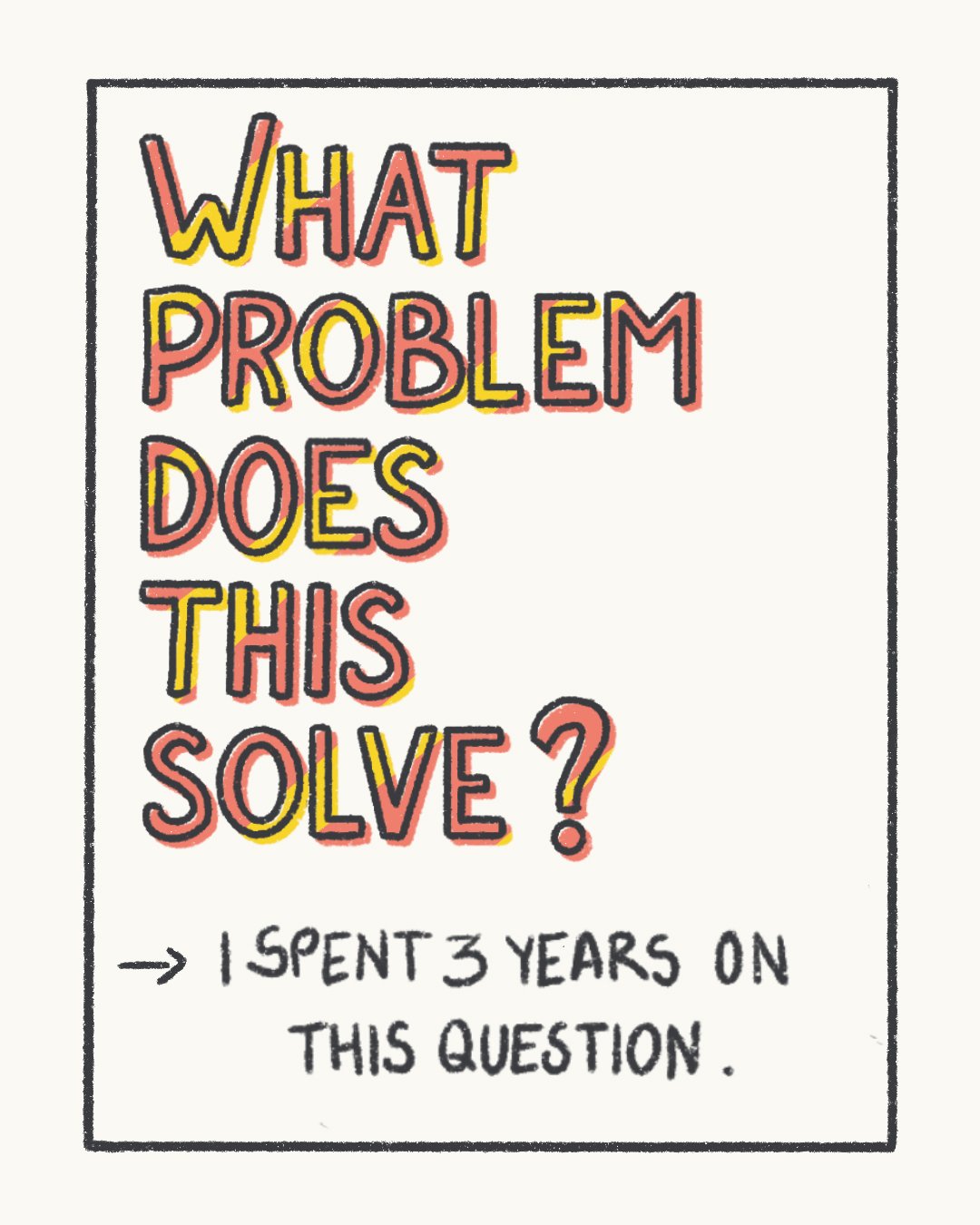
For three years, I cycled through: get excited about the business → try to validate → get stuck on that question → doubt the entire concept → give up → try again six months later.
This stuck point cost me three years. Three years of building in private. Three years of redesigning instead of marketing. Three years watching other illustrators launch and sell whilst I stayed stuck on question one.
I thought the problem was me not understanding validation deeply enough. Or that my artworks were not good enough. Or simply that my business concept was fundamentally flawed.
Turns out, the problem was the question itself.
The Framework Mismatch
Here’s the crazy part. I spent 15 years in luxury fashion operations. At brands like Mulberry, where the most basic handbag is £800, coats are £2K, and dresses £1.2K.
Nobody needs an £800 bag to carry their stuff. A £0.40 “Bag for Life” from Tesco solves the “carrying things” problem just fine.
But I never once heard anyone at those luxury companies ask, “what problem does this bag solve?” Because that’s not how desire-based businesses work. You aren’t solving a problem. You’re creating desire—for beauty, status, quality, self-expression. I’m not entirely sure what feeling people are trying to fulfil when they spend fortunes on the Labubu gremlin, but you get my point.
Yet somehow, when it came to my own creative business, I was trying to force it through a problem-solution framework. The same framework that works brilliantly for SaaS tools and productivity apps but makes no sense for art prints and illustrated homeware.
I was trying to measure temperature with a ruler. The tool itself was wrong for what I was measuring.
Most businesses fall into one of two broad categories:
Problem-Solution Businesses (SaaS, productivity apps, professional services):
Customer thinking: “I have X problem” → “This solves it” → “I’ll pay to make it go away”
Validation: What’s the pain point? How acute is it? Will they pay to remove it?
Desire-Fulfilment Businesses (art, fashion, jewellery, home decor, consumer goods):
Customer thinking: “I want to feel X” → “This creates that feeling” → “I’ll pay for that experience”
Validation: What desire does this tap into? How strong is it? Will they pay for that fulfilment?
The problem-solution framework works perfectly for booking systems, meal planning apps, and project management tools.
It breaks for illustrated tea towels, custom jewellery, and art prints.
Not because those businesses are flawed. Because they operate on completely different economics.
The Questions That Actually Work
Once I realised, I was using the wrong framework, everything shifted. I wasn’t failing at validation—I was trying to validate the wrong way. The business didn’t need fixing. The questions did.
If I could go back to that workshop in 2020, here’s what I needed to ask instead of “what problem does this solve?”
“Do people desire this?”
Not need it—desire it. Post your work where strangers can see it. Track strong reactions—not polite “nice!” from friends, but “I love this, where can I buy it?” from people who don’t know you.
If 10-15% of viewers express genuine desire, you’re onto something. If it’s crickets or just polite compliments, you need to test different work or different audiences.
“Will they pay my price for it?”
Will people pay £18 for your tea towel when you can get a set of 4 for £3 at IKEA? Test this before you buy stock. List items at your target retail price. See if anyone actually opens their purse. Pre-orders count. Family sympathy purchases don’t.
Success looks like: 5-10% of people who express desire actually purchase at your price. If they love it but won’t pay, your pricing doesn’t match your market.
“Can I reach enough of them?”
Calculate backwards: If you need £10K annual revenue at £20/item, you need 500 sales. If your conversion rate is 5%, you need 10,000 people seeing your work. Can you reach 10,000 ideal customers per year? What does that cost in time or money?
If you can’t reach your required audience without spending more than you’ll make, you have a distribution problem—not a product problem.
“Is my positioning differentiated enough?”
Search Etsy for “illustrated tea towels.” Now scroll through 100 shops. Can you articulate what makes yours different? Does that difference matter to customers, or is it only meaningful to you?
If you can’t explain your differentiation in one sentence, or if customers don’t care about what makes you different, positioning is your bottleneck.
What Actually Went Wrong
My illustration business didn’t struggle because it couldn’t solve a problem.
It struggled because:
I couldn’t reach enough of the right people (distribution problem)
I couldn’t market it with confidence (stuck-in-validation problem)
I was applying the wrong validation methodology (framework mismatch problem)
Those are completely different issues. Potentially solvable ones. But I never even got to analysing them because I was stuck on question one.
Here’s what I should have discovered in 8 weeks if I’d asked the right questions:
Week 1-2: Desire test → Post 10 pieces online, track reactions from strangers
Week 3-4: Price test → List 5 items at target retail price, see if anyone buys
Week 5-6: Reach test → Calculate required audience, test if achievable
Week 7-8: Positioning test → Research competitors, validate differentiation
Instead, I spent three years building without ever properly testing those four core assumptions.
When Creative Businesses DO Solve Problems
To be clear, sometimes creative work does solve problems.
A graphic designer helping a small business look professional—that’s solving a real problem. A wedding photographer capturing a once-in-a-lifetime event—that’s solving a real problem. An interior designer fixing a dysfunctional space—that’s solving a real problem.
These are services solving functional problems that happen to involve creativity.
My illustration business was products creating aesthetic joy that happen to have function (drying dishes).
Different categories. Different validation approaches.
If You’re Stuck Here Too
I don’t know if my illustration business would have been viable if I had asked the right questions from the start. Maybe the distribution problem was unsolvable. Maybe the positioning wasn’t differentiated enough. Maybe the market timing was wrong.
But I never even got to find out.
Because I was stuck on a question that didn’t apply to what I was building.
If you’re a creative trying to validate your work and you keep hitting the wall of “what problem does this solve?”—you’re not stuck because your business is flawed.
You’re asking the wrong question for the type of thing you’re building.
Desire-based businesses need different validation questions than problem-solution businesses. Both types can be viable. They just don’t validate the same way.
If you’re stuck on validation, operations, or strategic decisions and want to talk through it, let’s chat - I would love to hear from you.