The 5-Minute Revenue Reality Check (Before You Spend Months Building)
I have a £5,000 revenue goal for 2026. I ran it through Claude to see what that actually means in real purchases from real people.
The numbers were brutal.
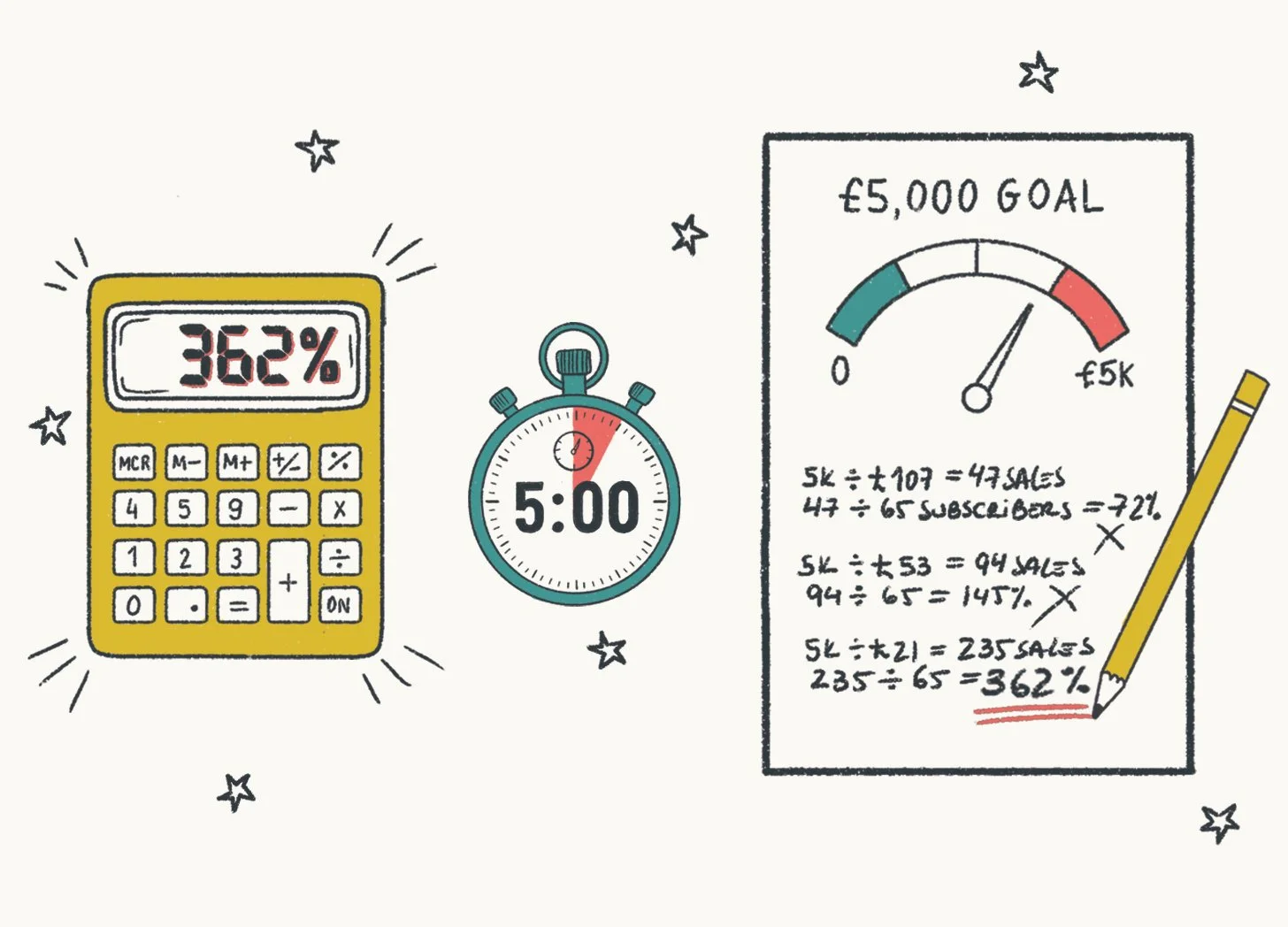
47 purchases at £107 each. Or 94 at £53. Or 235 at £21.
Then I looked at my audience growth rate: 1-2 new Substack subscribers per week. At that pace, I would have maybe 50-80 subscribers by July.
Even with a generous 10% conversion rate, that is 5-8 sales. Nowhere near 47. Nowhere near 94. And definitely not 235.
I had built an entire launch timeline around a target my audience could not support.
The moment I realized 362% conversion rates are not, in fact, a viable business strategy.
The Problem With Revenue Goals
Most of us set revenue targets based on feelings, not math.
“£5,000 sounds reasonable for a mum working around nap times.”
“£10,000 would be nice.”
“Six figures? That is the dream.”
We pick a number, work backwards to a price point, and hope it all adds up. But we skip the most important question:
How many actual humans do I need to say yes?
Because when you reverse-engineer a revenue goal into real purchases from real people, the math gets uncomfortable really fast.
The Revenue Validation Calculator
I built a simple prompt to force myself to face reality. Here is what I asked Claude:
The Prompt:
I have a revenue goal of £5,000 for 2026 from selling digital products (not client work).
My current audience:
- 8 Substack subscribers
- Growing at 1-2 new subscribers per week
- Expected size by July 2026: ~50-80 subscribers
Help me validate whether this revenue goal is realistic:
1. Break down what £5,000 means at different price points (£20, £50, £100, £150)
2. Show me how many sales I would need at each price point
3. Calculate what conversion rate I would need at each price point given my projected audience size
4. Tell me honestly: which scenarios are realistic and which are fantasy?
What The Math Showed Me
At £107 per product:
Need: 47 sales
My July audience: ~65 subscribers (midpoint estimate)
Required conversion rate: 72%
Reality: Fantasy. Even the best products rarely convert above 20%.
At £53 per product:
Need: 94 sales
My July audience: ~65 subscribers
Required conversion rate: 145%
Reality: Mathematically impossible. You cannot sell to more people than you expect to be part of your audience.
At £21 per product:
Need: 235 sales
My July audience: ~65 subscribers
Required conversion rate: 362%
Reality: Utter nonsense. This assumes each person buys 3-4 copies.
For context: industry-standard conversion rates for cold-to-warm email audiences sit between 2-10%. Anything above 20% requires an exceptionally engaged, pre-sold audience.
Claude, as always, was incredibly blunt: “With your current growth trajectory, none of these scenarios are viable for a July 2026 launch. Your audience simply will not be large enough to support £5,000 in revenue, regardless of price point or conversion rate.”
The Pivot
I sat with that for a day.
Then I realised: I had been asking the wrong question.
The question was not “How do I hit £5,000 by July?”
The question was “What do I actually need from 2026?”
And the answer: Clarity. Not revenue.
My timeline is unusual: I have until September 2027 before income becomes non-negotiable (when both my kids are in school and our household math changes). That gives me options most people do not have. So I am choosing to use that time to build properly, not to prove something prematurely. But it also means I am working 10-15 hours a week in nap-time windows - so 22 months of runway does not equal 22 months of full-time work. The constraint is real, just different.
So why was I rushing to launch in July?
Because I had convinced myself that 7 months of audience building “should” be enough. Because I wanted proof that this was working. Because waiting felt passive.
But launching to 65 people who barely know you is not validation. It is a recipe for the same 2023 failure when I Built a Shop on a Street Where Nobody Walked.
The New Plan
2026 is not a revenue year. It is a clarity year.
Here is what that means:
Primary goal: Build audience to 100+ engaged Substack subscribers by September 2026
Why 100? Because that is the minimum viable audience for a £5,000 product launch:
100 subscribers × 10% conversion rate = 10 sales
10 sales × £500 = £5,000
(Or 100 × 20% conversion × £250 = £5,000)
The math actually works at 100. It does not work at 65.
Secondary goal: Gain clarity on what I am actually selling
I have been testing AI workflows. Documenting systems. Writing about AI tools and sustainable creative business models. But I have not committed to which problem I am solving or what product I am building.
2026 is the year to figure that out. Not by planning. By testing.
How To Run Your Own Revenue Reality Check
If you have a revenue goal that might be built on hope rather than math, try this:
Step 1: Gather Your Numbers
You need three things:
Your revenue target
Your current audience size (email list, subscribers, followers who actually engage)
Your audience growth rate (new subscribers per week/month)
Step 2: Copy This Prompt
I have a revenue goal of [£X] for [YEAR] from [PRODUCT TYPE].
My current audience:
- [NUMBER] subscribers/followers
- Growing at [X] new subscribers per [WEEK/MONTH]
- Expected size by [LAUNCH DATE]: [PROJECTED NUMBER]
Help me validate whether this revenue goal is realistic:
- Break down what [£X] means at different price points (£20, £50, £100, £150)
- Show me how many sales I would need at each price point
- Calculate what conversion rate I would need at each price point given my projected audience size
- Tell me honestly: which scenarios are realistic and which are fantasy?
Step 3: Face The Truth
Claude (or ChatGPT/ or Gemini) will do the math. It will not lie to you. It will not soften the blow.
If your required conversion rate is above 20%, your timeline is wrong.
If it is above 50%, your pricing is wrong.
If it is above 100%, your entire strategy is wrong.
Step 4: Adjust
You have three levers:
Timeline: Give yourself more time to grow your audience
Price: Charge more (fewer sales needed) or less (lower barrier)
Audience: Grow faster (but be realistic about your capacity)
Pick the one that does not break you.
What I Learned
Running this validation exercise taught me something uncomfortable:
I had been optimising for the wrong metric.
I was focused on revenue. But revenue is an output, not an input.
The input is the audience. And not just any audience - an engaged audience who knows your work, trusts your expertise (the hardest part to build), and would actually buy from you.
8 subscribers with 75% open rates are worth more than 80 subscribers who never read your emails.
So the real question is not “Can I make £5,000 in 7 months?”
The real question is “Can I build an audience of 100 people who genuinely find value in my work in 9 months?”
And the answer to that? Yes. If I show up every week. If I provide value and trust. If I stop trying to rush the process.
The Framework
Here is what I am working from now:
AUDIENCE SIZE × ENGAGEMENT RATE × CONVERSION RATE × PRICE = REVENUE
Audience size: How many people are on your list
Engagement rate: What percentage actually read your content (open rates, click rates)
Conversion rate: What percentage of engaged readers buy
Price: What you charge
Most people obsess over the last two - price and conversion rate. But if your audience size is 10 people, even a 50% conversion rate at £500 only gets you £2,500. The math is unforgiving.
You cannot convert people who do not exist.
Where I Am Now
Week 9 of 12 in my Substack publishing experiment.
8 subscribers. 63-75% open rates. Zero revenue.
And for the first time in months, I am not panicking about it.
Because the goal is not £5,000 by July anymore.
The goal is 100 engaged readers by September. And that is actually achievable.
I will keep showing up every Saturday. Keep writing honestly about what I am learning. Keep documenting the workflows I am building.
And when I hit 100? Then we will talk about revenue.
Your Turn
If you have a revenue goal for 2026, run the validation calculator before you spend months building for it.
It takes 5 minutes. It might save you 6 months of wasted work.
Copy the prompt. Paste your numbers. See what the math says.
And if the math says “not yet”? That is not failure. That is data and strategy.
Use it.