My Friend Wanted To Build An App. I Told Her To Stop
My friend wanted to build an app. I stopped her.
She sent me excited voice messages about the business concept, and all the details already mapped out. She mocked up the interface. She was thinking about tabs, user flow, features, navigation.
In 2023, I would have said yes immediately and started building.
This time, I stopped her.
“You’re 10 steps too far ahead,” I said.
“We need to take 20 steps back.”
The pattern I recognised
I was still raw from analysing my own business failure.
I’d spent 6–10 months designing illustrated products before talking to a single potential customer. I built a shop on a street where nobody walked. I launched to 18 email subscribers — mostly family.
When I calculated my hourly rate, it came out to £0.50.
The pattern was obvious in hindsight: I fell in love with making products and forgot to check if anyone wanted to buy it.
And here was my friend, about to make the exact same mistake.
She had identified a real problem within her extended network—something they all experience but handle inefficiently through random messages and duplicate purchases. Her solution? An app. A marketplace platform for closed groups.
The idea itself? Actually pretty solid.
But she was doing exactly what I did in 2023: falling in love with the product before validating the behaviour.
But I’d learned this lesson the expensive way.
And I wasn’t going to let her do the same.
What I actually said
Not: “Is this a good idea?”
Everyone says yes to that.
But:
Will people actually use it?
Will they come back more than once?
Is this a habit or a novelty?
Is the problem such a nuisance to justify a new platform?
Because here’s what I know now that I didn’t know in 2023:
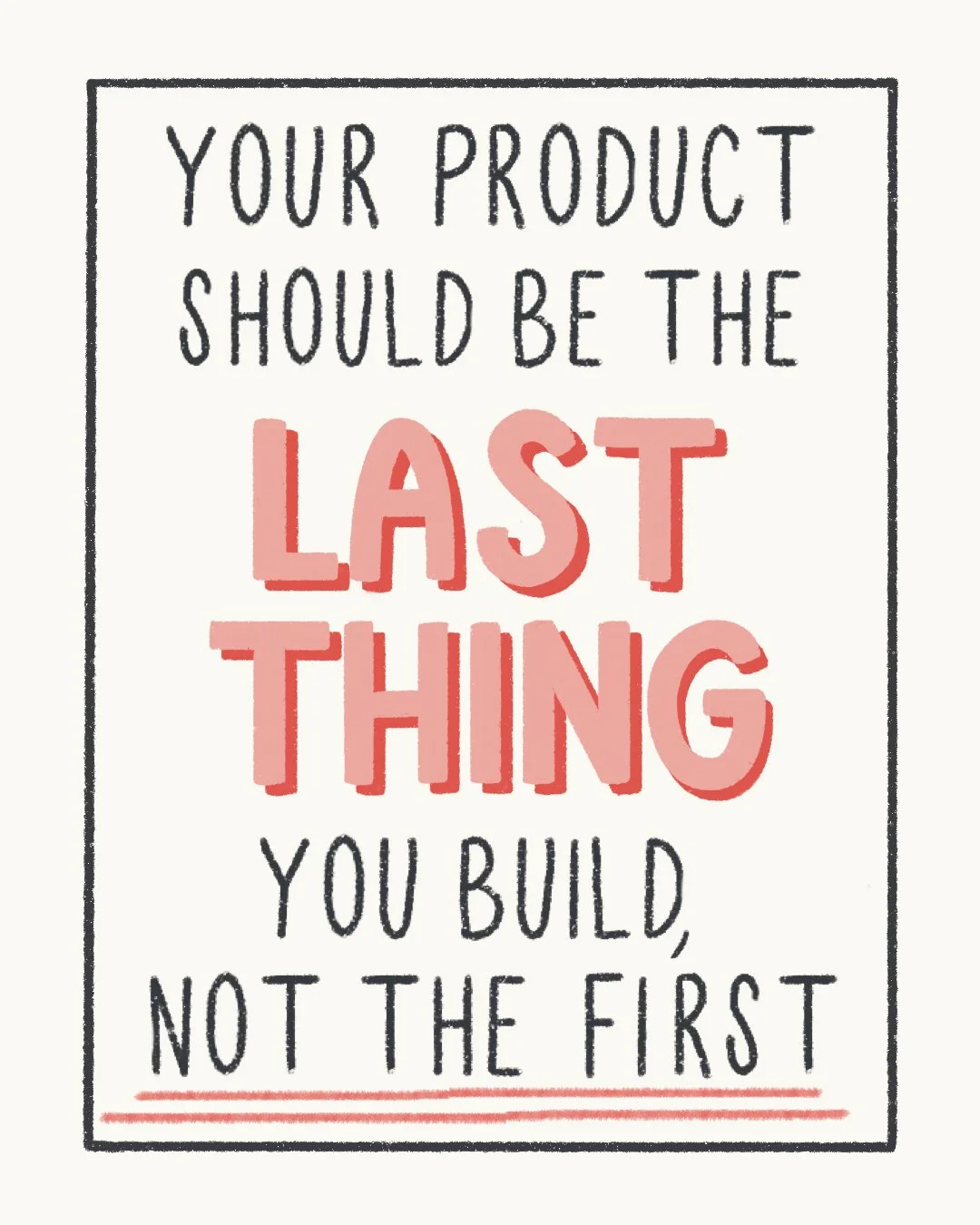
Your product should be the last thing you build, not the first.
The 5 questions you need to answer before you build
I walked her through the questions I wish someone had asked me:
1. Who specifically has this problem?
Not “busy parents” or “small businesses.”
Actual names of 5–10 people you could call today.
For my friend: Her extended network. She has a built-in test group of people who already experience this problem on some level. That’s good. That’s specific.
2. How are they solving it currently?
What’s the workaround?
What does it cost them in time, money, or mental energy?
And crucially — why are they tolerating it?
For them: Inefficiently. Through random messages, duplicate purchases, missed opportunities. There’s friction, but people are managing.
The question is: Is the current friction painful enough that they’ll change their behavior?
3. Will they actually use a solution?
Not “would you use this if it existed?”
But: will you use a scrappy, basic, slightly awkward version?
If they won’t use that, they won’t use a polished app either.
User behaviour doesn’t change just because something looks prettier.
4. What’s the smallest test?
Not a prototype.
Not a brand.
The cheapest way to test whether the behaviour exists.
For us: A simple, free platform. No app required. No development. No design. Just seeing if the behavior we’re trying to enable actually exists.
Test the need, not the interface.
5. What would prove you wrong?
Define failure criteria BEFORE you start.
For us: If fewer than half the group participates, or if nothing gets claimed in 2 weeks, or if it’s used once then abandoned—the idea is dead. Or at least needs major rethinking before we invest any real time or money.
This isn’t pessimism. It’s honesty.
Better to know in 2 weeks than after 6 months of building.
Or worse—3 years. (Trust me, I know!)
Here’s where it gets interesting
A couple of weeks ago I wrote about how “What problem does this solve?” can stop creative businesses in their tracks. Because not every business solves a problem—some fulfill desires instead.
Problem-Solution businesses: You’re in pain, I remove the pain (accounting software, childcare, plumbing)
Desire-Fulfilment businesses: You want something, I help you get it (illustration, jewellery, experience design)
My illustration business failed because I kept trying to validate it as a problem-solution business. Nobody wakes up thinking “I desperately need a calendar.” They might want one if they see it and love it, but there’s no urgent pain driving the purchase.
So which is my friend’s idea?
Actually... both.
It sits in an interesting middle ground:
A problem (inefficiency, duplication, waste)
A desire (access, variety, sustainability)
That changes how you validate it.
Problem side:
How painful is the workaround? Would they pay to remove it?
Desire side:
Do they light up? Do they tell others? Do they actually participate?
If you have desire without behaviour, people will say they love it — and never use it.
If you have function without desire, it’ll work — and nobody will care.
The test reveals which one you really have.
The test we’re running
We didn’t spend the rest of the call talking about tabs and features.
We spent it talking about validation.
We set up a 2–3 week test on a free platform:
Small group
No app
No design
No optimisation
We’re watching behaviour:
Do people post?
Do people claim things?
Will they come back?
If not, the idea is dead — or needs serious rethinking.
If yes, then we talk about building.
Either way, we learn.
And I get a case study for my exploration year.
The takeaway
If you’re sitting on a business idea right now, run it through those 5 questions before you build anything:
Who specifically? (names, not demographics)
How are they solving it now? (actual workarounds)
Will they use a simple version? (test commitment)
What’s the smallest test? (cheapest validation)
What proves you wrong? (failure criteria)
Your product should be the last thing you build, not the first.
Test the problem. Validate the need. Prove people will use it.
THEN—and only then—start thinking about what the interface should look like.
Three years ago I created beautiful products nobody bought.
Fifteen people did. Fourteen knew me. One was my mum (twice).
I’m not making that mistake again.
And I’m not letting my friends make it either.
This is Week 16 of 52. I’m figuring out what’s next after 15 years in fashion operations + 3 years building a creative business by testing positioning angles through conversations, content, and real work.
If you’re validating a business idea right now and want to talk through these questions, get in touch.
Your turn: If you’re building something right now, which of those 5 questions can you answer confidently? Which ones make you uncomfortable?
That discomfort is data.